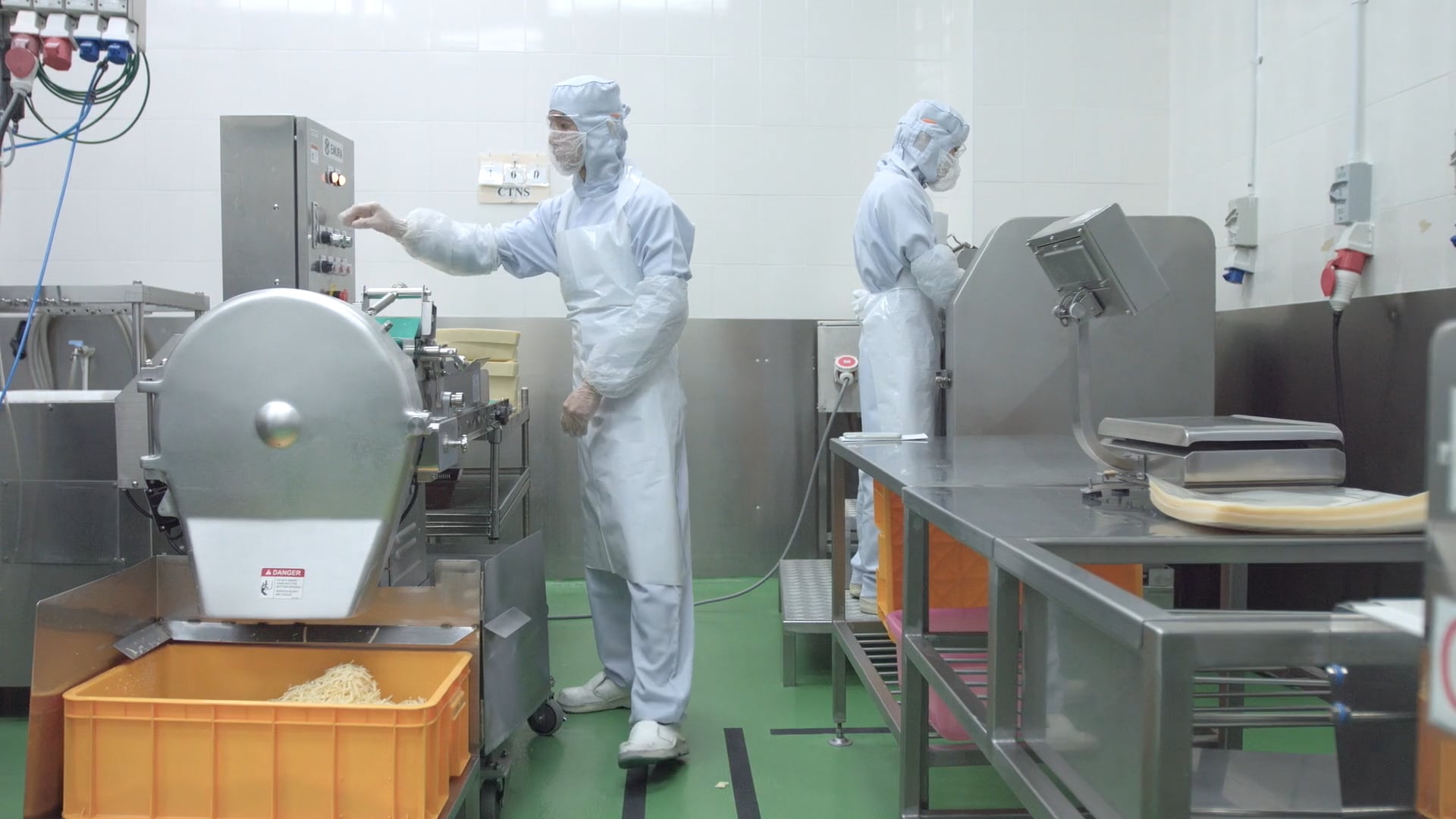
 film · Lacto Asia Pte Ltd
 Sector 09 — Food Manufacturing & Agritech
Lacto Asia Pte Ltd
Lacto Asia makes commercial cheese in Singapore and trades dairy ingredients across Asia. The Singapore subsidiary of Tokyo-listed Lacto Japan runs a cheese factory at KA FoodLink and a trading desk at The Central, supplying eight cheese formats engineered to behave under specific heat — 200°C dry, 180°C oil, 100°C water — to bakeries, food manufacturers and food-service operators in ten markets. A new 6,500 m² plant is commissioning — operations from the second half of the year to November 2026, full production scheduled for the year to November 2027.
Most cheese is sold on taste. Lacto Asia sells it on thermal behaviour. Its Singapore factory makes eight formats — standard, melty, heat resistant, heat stable, spread, processed cream, liquid and shredded — each specified against what a customer will do to it: deep-fry it at 180°C, bake it into a bun, boil it in water, put it on a pizza. It is the core manufacturing company of Lacto Japan's Asian cheese business, and it is about to move into a new plant built to expand supply two and a half times over.
Film — Lacto Asia.
Cheese as an engineering specification
The interesting document Lacto Asia publishes is not a product list but a reference table. Down one axis run its cheese formats: standard, melty, heat resistant, heat stable, cheese spread, processed cream cheese, liquid cheese and shredded cheese. Across the other run the things a customer might actually do — hold it at 200°C for ten minutes of dry heat, boil it at 100°C, deep-fry it at 180°C in oil, coat it in breadcrumbs or tempura batter, or expose it directly to a heat source.
Every cell is a yes or a no. Heat-stable cheese survives all six of those conditions; standard cheese survives almost none of them. That is the whole business in one grid: a food manufacturer putting cheese inside a chicken nugget, a cordon bleu, a sausage, a crab cake or an otah needs it to still be cheese when it comes out of the fryer.
The applications the table covers say a good deal about who buys it — bakery toppings, fillings, pao, biscuits, cheesecake and pizza toast; meat products from luncheon meat to cutlets; seafood from surimi paste to chikuwa; and then ice cream, fried rice, sauces, soups and sushi.
Two divisions, one country
Lacto Asia runs two distinct operations in Singapore. The trading division, at The Central on Eu Tong Sen Street, handles dairy ingredients — milk powders and mixtures — selling into Singapore and South Korea and exporting powdered milk mixtures back to Japan. The cheese division, at KA FoodLink on Kampong Ampat, manufactures.
The factory runs a full production line rather than a packing operation: cheese cutting and crushing, weighing, mixing and cooking, filling, cooling, in-house quality checking, metal detection, labelling and packing, then warehousing and loading. Product goes out under the Foodtech and Choosy brands, the latter covering natural cheeses — shredded mozzarella, cheddar, gouda and parmesan — alongside plant-based alternatives.
Markets reach across Singapore, Malaysia, Indonesia, Thailand, Vietnam, Hong Kong, Taiwan, China, Korea and Japan.
The core of a regional network
Lacto Asia is the core company of Lacto Japan's Asian business — the hub through which the Tokyo-listed parent runs a network of subsidiaries in Malaysia, Thailand, Indonesia, the Philippines and China.
Three of those operations manufacture. Lacto Asia in Singapore and Foodtech Products in Thailand run the group's own cheese plants, with PT Pacific Lacto Jaya in Indonesia as an equity-method affiliate. Singapore and Thailand both make shredded cheese processed from natural cheese as well as processed cheese, a line the group notes is growing on pizza demand.
Across that Asian cheese manufacturing and sales division, volume reached 5,640 metric tonnes on net sales of ¥6,391 million in the year ended November 2025, up from 5,422 tonnes the year before.
The new plant
Lacto Asia is relocating from its current Singapore plant to a new one. The building runs to approximately 6,500 m² of floor area and represents an investment of approximately ¥3.5 billion. It will produce processed cheese and shredded cheese, and the parent describes it as a key production hub for Asia.
Operations begin in the second half of the financial year ending November 2026, with full production scheduled for the financial year ending November 2027 and a deliberate period of parallel operation while lines transfer from the existing plant. The stated aim is to increase product supply two and a half times over, taking the Asian division from 6,800 tonnes in the year ending November 2026 to 10,000 tonnes by the year ending November 2028.
In July 2026 Lacto Japan placed its newly established Vietnam subsidiary under Lacto Asia, consolidating the group's Southeast Asian cheese business under the Singapore company.
The sequencing is the giveaway that this is a regulated food operation rather than a warehouse: the first year's work is acquiring manufacturing licences and certifications, then introducing new lines and transferring existing ones, then automating and improving productivity.
Why Singapore
There is no dairy herd in Singapore. Every input arrives by sea, which makes the choice of location a deliberate one rather than an accident of geography.
What Singapore offers this business is what it offers a lot of food manufacturers: a regulatory regime whose approvals travel, halal certification that opens Malaysia and Indonesia, and a position from which a manufacturer can serve ten markets without being resident in any of them. The buyers are Japanese restaurant operators expanding across the region, local food-service companies, food manufacturers and bakeries — customers who need consistent specification more than they need proximity.
CLAIM THIS RECORD
Is this your company?
Lacto Asia Pte Ltd is on the Singapore Industry Index as a reference record, compiled from public sources. Claiming it is free — correct the facts, add capabilities and certifications, appear on more pages, and receive enquiries routed directly to you.
Spotted an error? Claiming is the fastest way to fix it — or write to us via Contact.