 film · Halcyon Agri Corporation Limited
 Sector 09 — Food Manufacturing & Agritech
Halcyon Agri Corporation Limited
Halcyon Agri runs an integrated natural rubber supply chain from Singapore — plantations in Cameroon and Ivory Coast, processing factories across Indonesia, Malaysia, China, Thailand and Ivory Coast, and a distribution arm selling into the world's tyre makers and industrial polymer users. The Singapore-headquartered group employed 12,481 people across more than 100 locations.
Almost every tyre contains natural rubber that no synthetic has managed to replace, and almost all of it starts with a smallholder in Southeast Asia or West Africa cutting a tree. Halcyon Agri is one of the companies that turns that into an industrial commodity a tyre major can buy to specification — 12,481 people, more than 100 locations, three operating platforms. It is directed from an office on Clemenceau Avenue.
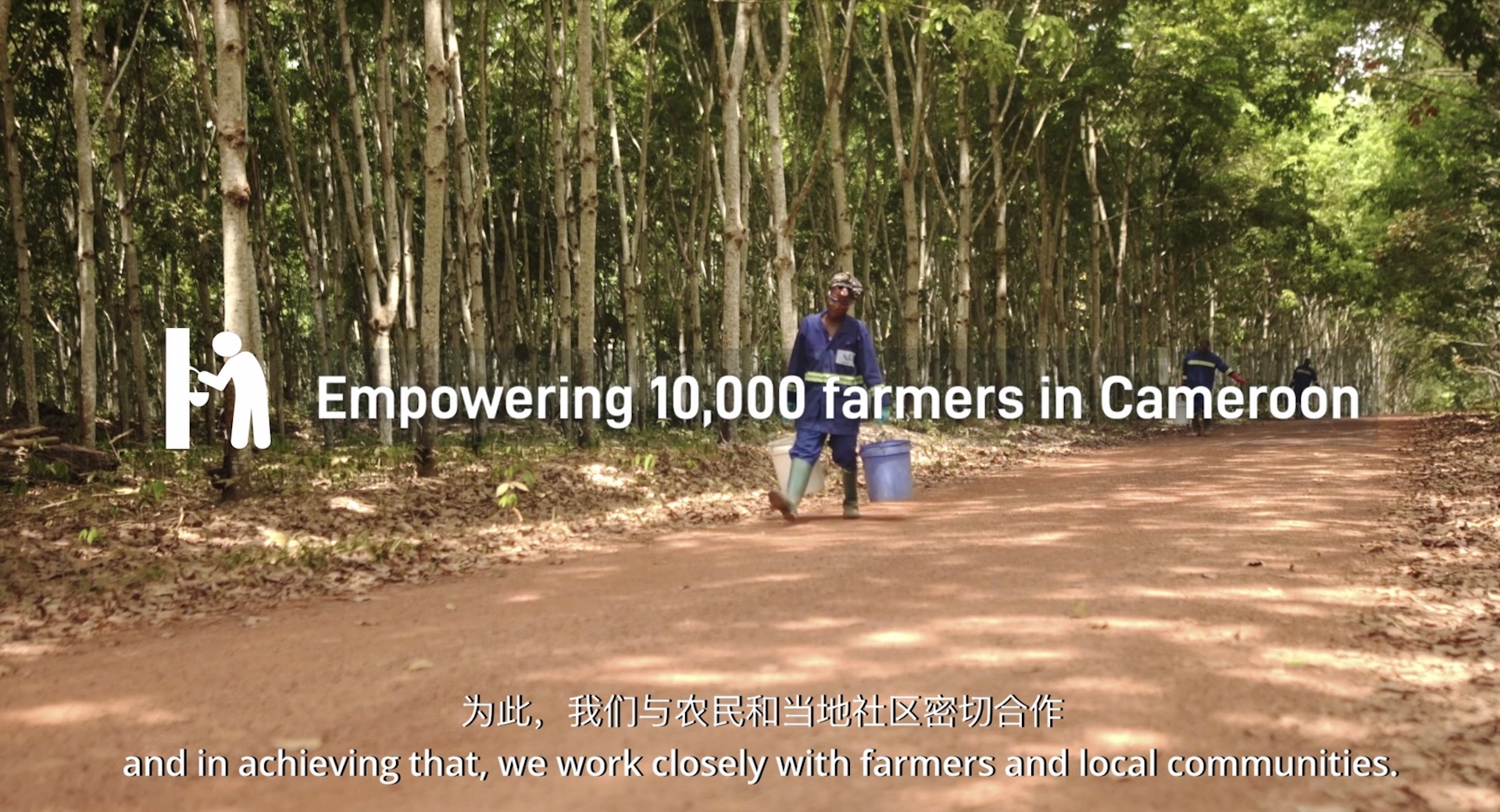
Film — Halcyon Agri.
A franchise built on trees
Halcyon Agri describes itself as an integrated natural rubber supply chain franchise, and the word integrated is doing real work. The group holds positions at every stage: plantations that grow the trees, factories that process the latex and cup lump into tyre-grade blocks, and a distribution business that sells the finished product into consumption markets.
As at the financial year ended 31 December 2025 it employed 12,481 people. The concentration is where the rubber is: 7,136 of them work in West and Central Africa and 5,130 in China and Southeast Asia, against 70 across Europe and the Americas. Operations span Ivory Coast, Cameroon, Indonesia, Malaysia, China, Thailand, Singapore, Vietnam, Türkiye, the United Kingdom, the Netherlands, Germany and the United States.
Three platforms
The group runs three operating platforms, and they map onto three different businesses with three different economics.
Halcyon Rubber Company owns and operates the factories, across Indonesia, Malaysia, China, Thailand and Ivory Coast. All of them are approved to supply tyre-grade rubber to tyre majors globally. This is a mid-stream business, and the group is explicit about what drives it: processing margin — the selling price of the finished product less what was paid to smallholder farmers, less conversion costs and overheads.
CMC Plantations owns the group's Cameroon estate — which the group describes as one of the largest commercially owned and operated rubber plantations anywhere — plus a smaller estate in Malaysia. Its economics run on a different clock entirely. A planted rubber tree takes an average of five to seven years before it yields its first drop of latex, and then stays productive for around thirty. Fewer than half of the group's planted areas remain immature, so volume rises as the young trees come into tapping — and because plantation overheads are largely fixed, rising volume pulls unit cost down.
CMC International supplies specialist polymers for industrial and non-tyre applications, and is the sole distribution arm for the group's own plantation output — which lets the group capture margin from the tree to the customer's destination.
Traceability as the product
The EUDR postponement cost Halcyon Agri a price premium, but it did not change what the group has been building. Compliance work continued through the year: supplier data was centralised into the group's digital infrastructure, and in-house geospatial capability was developed so teams could assess deforestation and land-use risk directly from satellite data rather than buying the assessment in.
That capability sits on a substantial certification base. Group sites hold ISO 9001, ISO 14001 and ISO 45001 across processing operations in China, Indonesia, Malaysia, Thailand, Ivory Coast and Cameroon; FSC chain-of-custody certification at trading operations in Malaysia, Thailand and the Netherlands; and IATF 16949, the automotive quality standard, at Hevea KB in Perak. Internal quality auditing runs against HeveaPro, the group's manufacturing standard for sustainable natural rubber — 448 checks across 20 factories during the year.
For a buyer, this is the actual product. Anyone can sell rubber. Selling rubber a tyre major can put in a European-bound tyre, with the tree it came from documented, is a narrower trade.
Singapore is the head, not the hands
Nothing is processed in Singapore. The factories are in Indonesia, Malaysia, China, Thailand and Ivory Coast; the plantations are in Cameroon, Malaysia and Ivory Coast; the terminals and sales offices sit in the consumption markets.
What is here is the head office at Haw Par Centre on Clemenceau Avenue — the capital, the trading and risk functions, the sustainability and compliance frameworks, and the group's digital arm, Agridence. It is a familiar Singapore pattern and worth stating plainly: the commodity is grown and processed elsewhere, and directed from here.
CLAIM THIS RECORD
Is this your company?
Halcyon Agri Corporation Limited is on the Singapore Industry Index as a reference record, compiled from public sources. Claiming it is free — correct the facts, add capabilities and certifications, appear on more pages, and receive enquiries routed directly to you.
Spotted an error? Claiming is the fastest way to fix it — or write to us via Contact.